Split your purchase into 3 payments with Klarna
Home accessibility has changed significantly over the past few decades. Where once limited mobility often meant relocating or restricting daily life to one floor, modern stairlifts have transformed what is possible within the home.
Today’s stairlifts are more advanced, more adaptable, and far more user-friendly than earlier models. They are no longer seen as basic mobility aids, but as reliable, long-term solutions that allow people to remain independent in their own homes.
This guide explores how modern stairlifts have improved home accessibility, the key innovations behind these changes, and what it means for homeowners and families.
One of the most important improvements modern stairlifts have brought is the ability for individuals to remain independent for longer. In the past, stairs were often a barrier that forced people to adapt their lifestyle or consider moving home.
Modern stairlifts remove that barrier. They provide safe, consistent access between floors, allowing users to continue using their entire home without assistance.
This shift has had a meaningful impact on quality of life, particularly for older adults who want to remain in familiar surroundings.
Maintaining independence is not just about mobility. It also supports confidence, routine, and overall wellbeing.
Early stairlifts were often bulky and limited in design. Modern models have evolved to become more compact, discreet, and adaptable to different home environments.
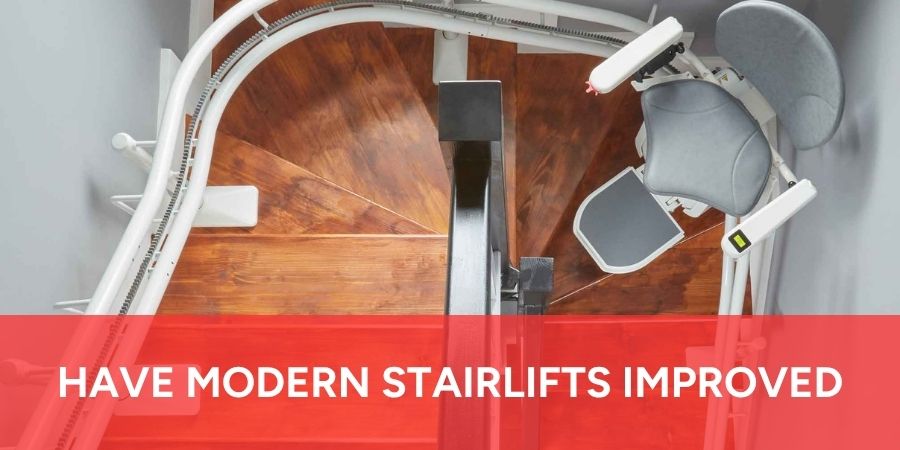
Improved engineering has made it possible to install stairlifts in tighter spaces without compromising safety or comfort. Folding seats, armrests, and footrests allow the staircase to remain accessible for other users.
Design has also become more refined, with stairlifts blending more naturally into the home rather than standing out as purely functional equipment.
This makes them a more practical and appealing option for a wider range of households.
One of the biggest improvements in modern stairlifts is their ability to adapt to almost any staircase layout.
Straight staircases remain the simplest to work with, and homeowners can explore straight stairlift options for quick and efficient solutions.
However, advances in manufacturing now allow curved stairlifts to be designed with precision. These systems follow the exact shape of the staircase, including bends, corners, and landings.
For more complex homes, reviewing curved stairlift solutions shows how tailored these systems have become.
This level of adaptability means that very few homes are unsuitable for a stairlift.
Safety has always been a priority, but modern stairlifts include far more advanced features than earlier models.
Built-in sensors can detect obstacles on the stairs and stop the lift automatically. Seatbelts provide added security, while smooth start and stop functions prevent sudden movements.
Battery backup systems allow the stairlift to continue operating during power cuts, which is essential for reliability.
These improvements reduce risk and provide reassurance for both users and their families.
Modern stairlifts are designed with comfort in mind. Seats are more supportive, controls are easier to use, and the overall experience is smoother.
Features such as swivel seats make it easier to get on and off safely at the top of the stairs. Remote controls allow the lift to be called or sent away when not in use.
For users with specific mobility challenges, options such as standing or perch stairlifts provide alternatives to traditional seating.
These improvements make daily use more practical and less physically demanding.
Installation has become much more efficient over time. Modern stairlifts are designed to be fitted quickly, often within a single day.
Because the rail is attached to the stairs rather than the wall, there is no need for major building work. This reduces disruption and makes installation possible in a wider range of homes.
For straight staircases, the process can often be completed in just a few hours.
This speed and simplicity make it easier for households to respond quickly when mobility needs change.
Cost has historically been a barrier for some households, but modern stairlifts have become more accessible through a wider range of options.
Reconditioned stairlifts provide a lower-cost alternative without sacrificing reliability. These units are refurbished and tested before installation.
Exploring reconditioned stairlifts can help make home accessibility more affordable.
In addition, finance options and flexible payment plans have made it easier to spread the cost over time.
This broader range of choices allows more people to access the support they need.
Modern stairlifts are designed to support a diverse range of users. This includes individuals with different mobility challenges, body types, and personal preferences.
Heavy-duty models are available for higher weight capacities, while compact designs suit smaller staircases.
Standing stairlifts provide an option for those who cannot sit comfortably, while outdoor models extend accessibility beyond the home.
This flexibility ensures that solutions can be tailored to individual needs rather than forcing users to adapt to a single design.
The improvements in stairlift technology have had a lasting impact on how people approach home living. Instead of viewing stairs as a limitation, they can now be managed safely and effectively.
This reduces the need for major home alterations or relocation. It also allows individuals to remain in familiar surroundings, which is particularly important for emotional wellbeing.
For families, stairlifts provide reassurance that loved ones can move safely within the home.
Over time, this contributes to a more stable and comfortable living environment.
| Feature | Older Stairlifts | Modern Stairlifts |
|---|---|---|
| Design | Bulky and basic | Compact and discreet |
| Safety | Limited features | Advanced sensors and controls |
| Installation | More disruptive | Quick and minimal impact |
| Adaptability | Limited staircase options | Fits most layouts |
| Accessibility | Restricted availability | Wider range of users and budgets |
This comparison highlights how far stairlift technology has progressed and why it plays such an important role in modern home accessibility.
Modern stairlifts have transformed home accessibility by making it safer, more practical, and more adaptable than ever before. They allow individuals to maintain independence, reduce the risk of falls, and continue using their homes fully.
Advances in design, safety, and installation have made stairlifts suitable for a wide range of properties and users. At the same time, improved affordability has made them accessible to more households.
With the right solution in place, a stairlift can remove one of the most common barriers within the home and provide lasting confidence in everyday living.