Split your purchase into 3 payments with Klarna
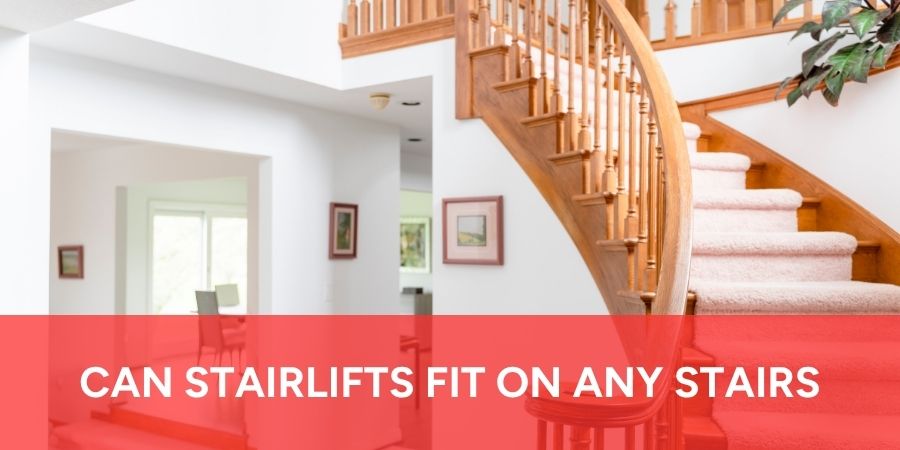
This is one of the most common questions asked when considering a stairlift. Many people assume their staircase may be too narrow, too steep, or too complex to accommodate a lift. In reality, most staircases can be fitted with a stairlift, but the type of solution will depend on the layout, structure, and available space.
Modern stairlift design has advanced significantly, allowing systems to be adapted to a wide range of homes. From simple straight staircases to multi-level curved designs, there are options available for most situations.
This guide explains where stairlifts can be installed, what limitations exist, and how to determine the best solution for your home.
In the majority of cases, yes, a stairlift can be fitted. The key factor is not whether the staircase is standard, but whether it can safely support a rail and provide enough space for operation.
Stairlifts are fitted directly to the stairs rather than the wall, which means structural changes are rarely required. This makes installation possible in homes where wall mounting would not be suitable.
Even staircases that appear challenging at first can often be adapted with the right design.
Straight staircases are the simplest to work with. These run in a single line without any turns or landings.
They can usually be fitted with a standard rail, making installation quick and cost-effective.
Homeowners with this layout can explore straight stairlift options as a starting point.
In most cases, these can be installed within a few hours with minimal disruption.
Staircases with bends, corners, or intermediate landings require a curved stairlift. These systems use a bespoke rail that is manufactured to match the exact shape of the stairs.
While more complex, this approach allows the stairlift to move smoothly around turns and across different levels.
For these layouts, reviewing curved stairlift solutions will provide a clearer understanding of what is possible.
Almost any staircase shape can be accommodated with a custom rail.
Narrow stairs are a common concern, particularly in older properties. In many cases, a stairlift can still be installed using compact models with folding seats and footrests.
These designs allow other users to continue using the stairs when the lift is not in use.
There are minimum width requirements, but they are often less restrictive than people expect.
A professional survey will confirm whether there is enough space for safe installation.
Steep stairs can also be fitted with a stairlift. The rail is designed to follow the angle of the staircase, ensuring a smooth and controlled journey.
Additional safety features may be recommended in these cases, such as enhanced seat support or powered swivel functions.
The key is ensuring stability and comfort throughout the journey.
Stairlifts are not limited to indoor use. Outdoor stairlifts are specifically designed to withstand weather conditions, including rain, temperature changes, and exposure to the elements.
They include protective covers and durable materials to maintain performance over time.
This makes them suitable for garden steps, porches, and external access points.
While most staircases can accommodate a stairlift, there are a few situations where installation may be more challenging.
Extremely narrow staircases with very limited clearance may not provide enough space for safe use.
Staircases with unusual structural issues, such as loose steps or inadequate support, may require repairs before installation.
In rare cases, alternative solutions such as home lifts or through-floor lifts may be more appropriate.
These situations are uncommon, but they highlight the importance of a professional assessment.
One of the main factors in determining suitability is space. Stairlifts require enough room for both the rail and the user to move safely.
| Requirement | Typical Measurement |
|---|---|
| Minimum staircase width | Approximately 65 to 70 cm |
| Folded stairlift clearance | Leaves space for other users |
| Landing space | Enough room for safe entry and exit |
These are general guidelines. Exact requirements depend on the model and the specific layout of the staircase.
Compact designs can often work in tighter spaces than expected.
One of the reasons stairlifts can be fitted to most stairs is the level of customisation available. Modern systems are designed to adapt to the home rather than the other way around.
Curved rails can be shaped to follow complex layouts. Folding components reduce the space required when the lift is not in use. Additional features can be added to improve safety and comfort.
This flexibility allows solutions to be created for staircases that might previously have been considered unsuitable.
No matter how straightforward or complex the staircase appears, a professional survey is essential. This involves taking precise measurements, assessing the structure, and identifying any potential challenges.
The survey ensures the stairlift will fit correctly and operate safely. It also provides an accurate cost estimate and timeline for installation.
Attempting to judge suitability without a proper assessment can lead to incorrect assumptions.
An experienced installer will be able to recommend the most appropriate solution based on both the staircase and the user’s needs.
For suitable staircases, particularly straight ones, reconditioned stairlifts can provide a more affordable solution.
These units are refurbished and tested to meet safety standards, offering reliable performance at a lower cost.
Exploring reconditioned stairlifts can be a practical option when budget is a concern.
Availability depends on the type of staircase and the models currently in stock.
While fitting a stairlift is often possible, the goal is not just to install one, but to ensure it works safely and comfortably in daily use.
This means considering how easy it is to get on and off the lift, how much space remains on the stairs, and how the system fits into the overall layout of the home.
A well-planned installation should feel natural and unobtrusive, supporting independence without creating new challenges.
Most staircases can accommodate a stairlift, thanks to modern design and customisation. Straight stairs are the simplest to work with, while curved and more complex layouts can be adapted with bespoke solutions.
Even narrow or steep staircases can often be fitted with the right model. The key is understanding the specific requirements of the space and choosing a system that meets both practical and safety needs.
A professional assessment remains the most reliable way to confirm what is possible. With the right approach, a stairlift can be installed in the vast majority of homes, providing safe and dependable access between floors.